How to build a research practice
A mini guide to knowledge gardening 🌀🌱

Over the past couple years of developing my research practice, I’ve come to realise that a research practice is an end in itself, and not a means to an end. Sure, you could be researching for a paper, working on a doctorate, or writing an article, and your knowledge garden will help you do that. But developing a research practice as a way of engaging with the world, with yourself and the things that move you, is in my opinion, far more valuable.
My research practice is a fundamental pillar I use to move through the world. I’ve written about note-taking as a way of finding out who you are. I return to my research practice in all states of being; if I’m feeling inspired and want to learn more, and if I’m worried about something and want to dive deeper, and if I’m bored and want to disappear into a rabbit hole for a while. My research practice is a tool I have in my arsenal I know I can always turn to.
If you’re interested in developing your own research practice, I’ve put together a couple places you can start. ꩜
Start with things that shimmer
If you’ve never taken notes before, or maybe you have an empty Capacities space staring back at you, it can definitely feel overwhelming. The only way to move past this is also something most people don’t want to hear: you have to start writing things down. There aren’t really shortcuts or ways around this. You don’t need the perfect setup, or the perfect theme or plugin, or even a direction you want to go in. You just have to start writing down things that call to you.
Resonance is a muscle, and the more you flex it, the stronger it gets.
Start by jotting bullet points down in your daily notes of things that interest you, and you can turn those into objects later. I do this if I have a theme I want to research or a topic I know I want to dive deeper into. It goes into my daily note where I can process it out whenever I want to get to it.
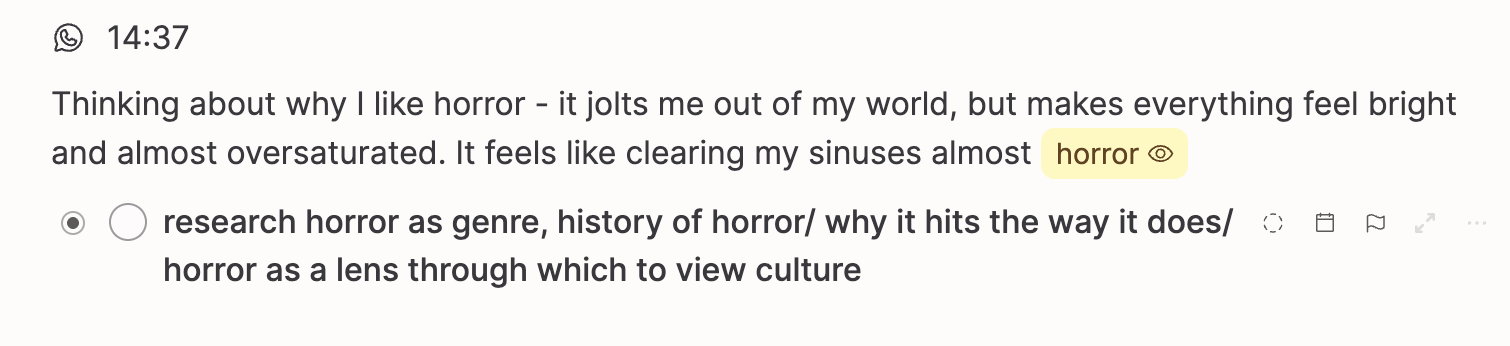
You can also start by just saving things into Raindrop or Sublime and building your resonance filter. Beth has an amazing article about this.
Think of this step as the data collection phase. You’re hunting for information about yourself.
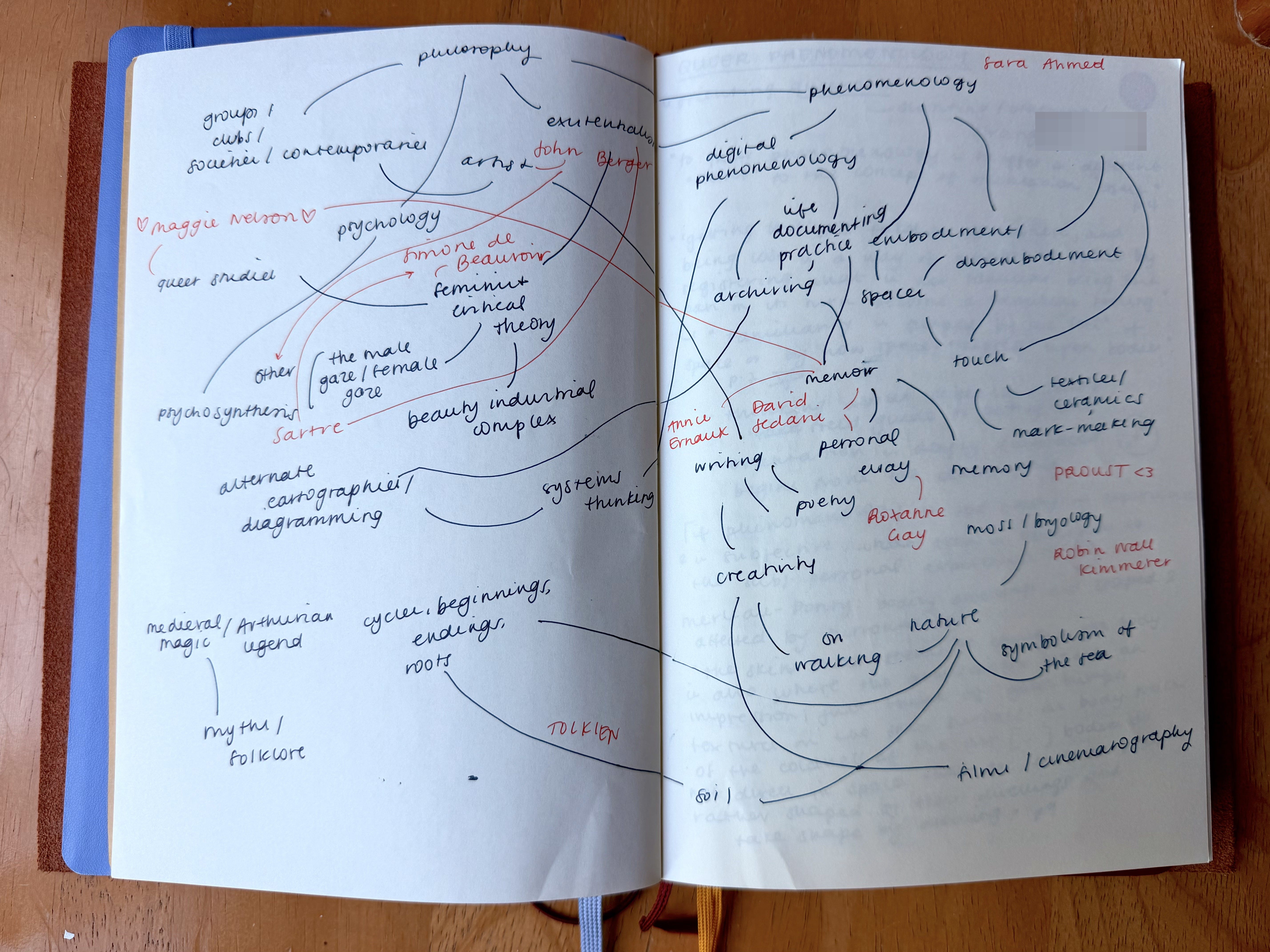
You can also make a mind map of all the topics you’re interested in, and link them together. I do this on paper. Go really big and broad with your topics, and then draw lines to connect any that might be relevant. My most recent one looks like this:
Connect your notes
Now that you have some notes in your Capacities space, you can start connecting them. Your notes can be anything: weblinks, images, pdfs, topic notes etc. The power of networked note taking lies in the actual connecting of the notes, so don’t be shy here. Link your notes using @ in the body of a note, or through an object property.
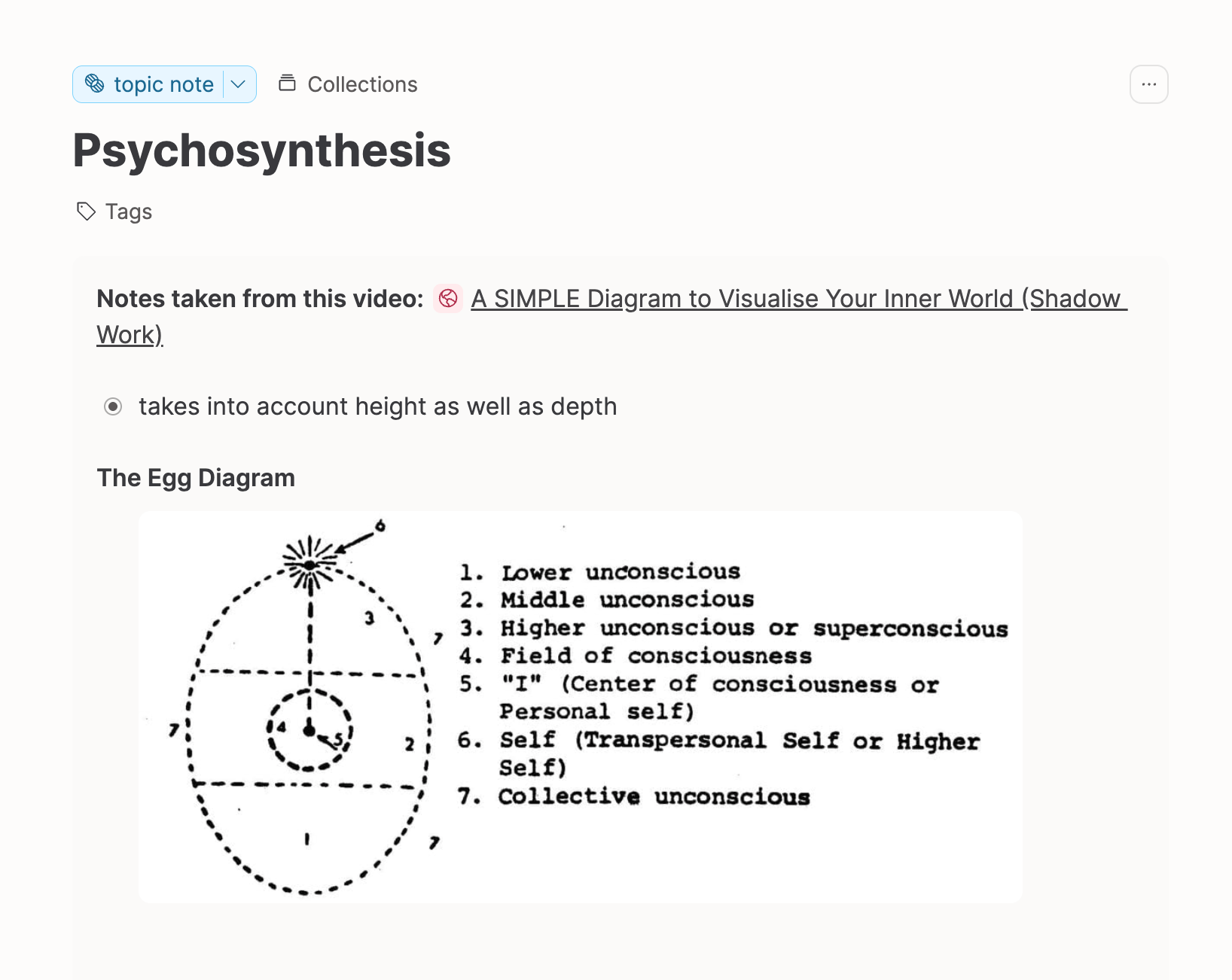
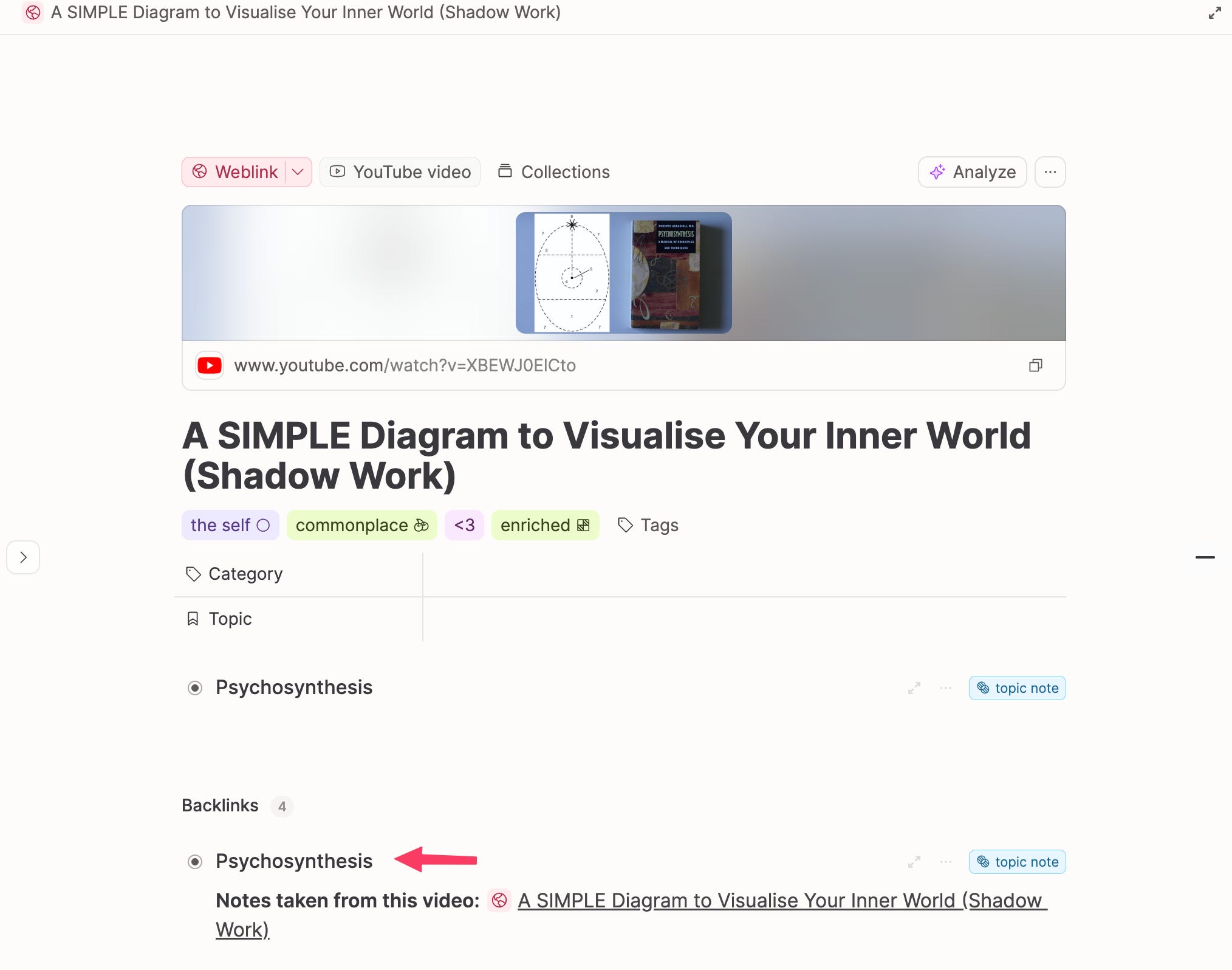
Below you can see I linked a weblink in the body of my Psychosynthesis topic note, and you can see the Psychosynthesis topic note under the backlinks of that weblink. Now these notes are connected!
For the most part, that’s all you need to do. Flex your resonance muscle, take notes on the things that interest you, and connect them when connections arise.
Related content catch connections for you
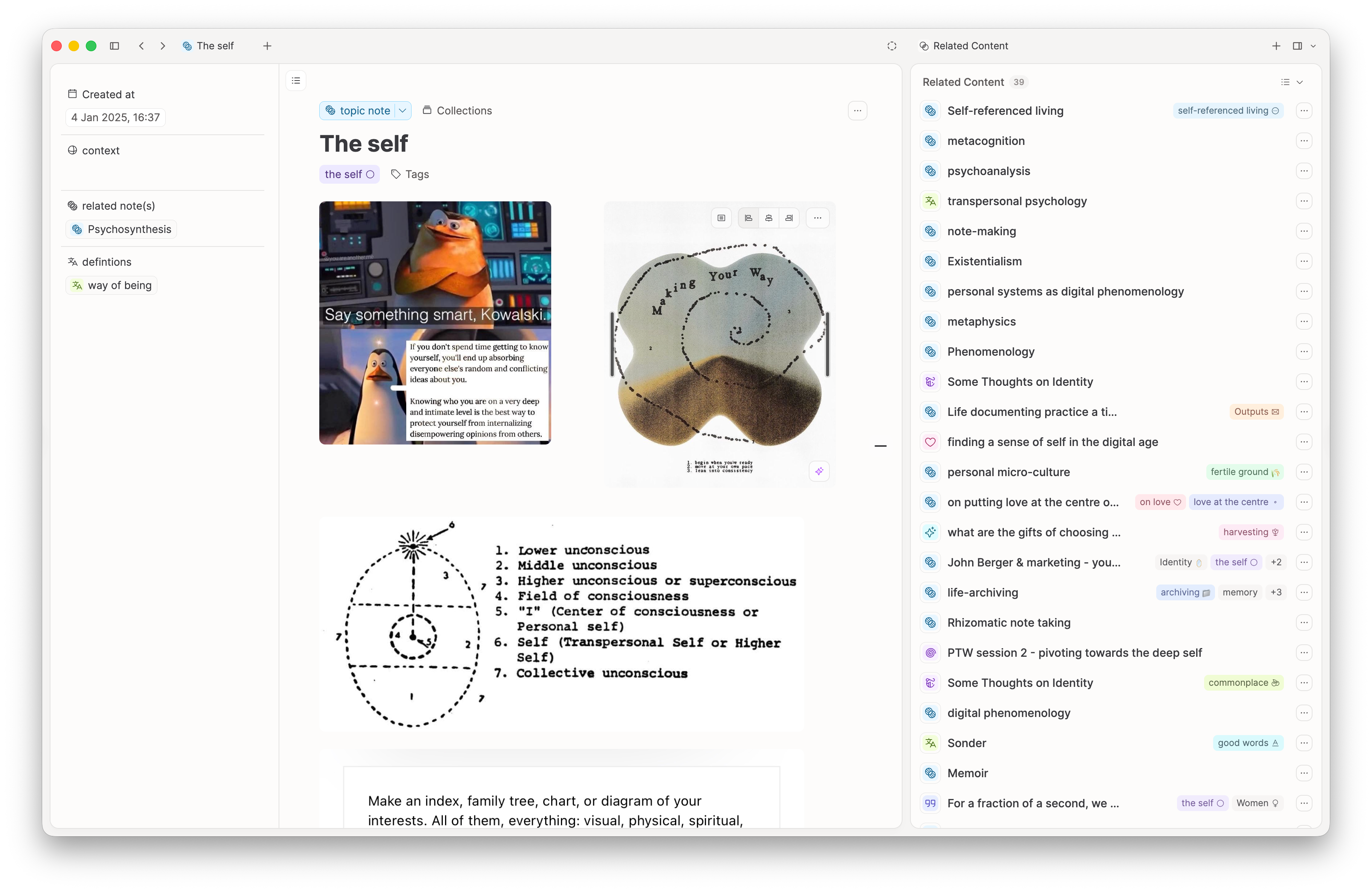
One of my favourite features in Capacities, and arguably one of the most powerful, is the related content feature. Sometimes you know that two notes are connected (e.g. The Way by Swann’s, the book note, is connected to ‘Marcel Proust’, the person note), but sometimes the connections are more tenuous. Sometimes it isn’t inherently clear whether two notes are connected or not, and this is where related content comes in. If you’re looking at a central note, related content will automatically find other notes in your space that are possibly related to the central note. This means that notes that could be connected, but don’t have direct connections or backlinks between them are surfaced for you to review. This way, no threads are ever truly lost.
Review your notes often
I spend probably as much time reviewing my notes as I do taking new ones. I have a regular Friday review I do, as well as a fun Sunday activity where I pull any saves from Sublime into Capacities if they are relevant.
You can also set up randomiser queries for your notes that resurface notes for you. I have a randomiser query set up for my ‘to research’ topics, and if I have time and want to take notes on something I’ll shuffle the query and pick whatever topic speaks to me on that day. Set a timer for 30 minutes and see what you can learn. Research doesn’t need to have a high barrier to entry. If you want to make it a regular practice, lower the bar.
The best way to do this is to set up some processing queries. I have a couple set up that I have embedded into a page, so they’re all there ready to go in one place.
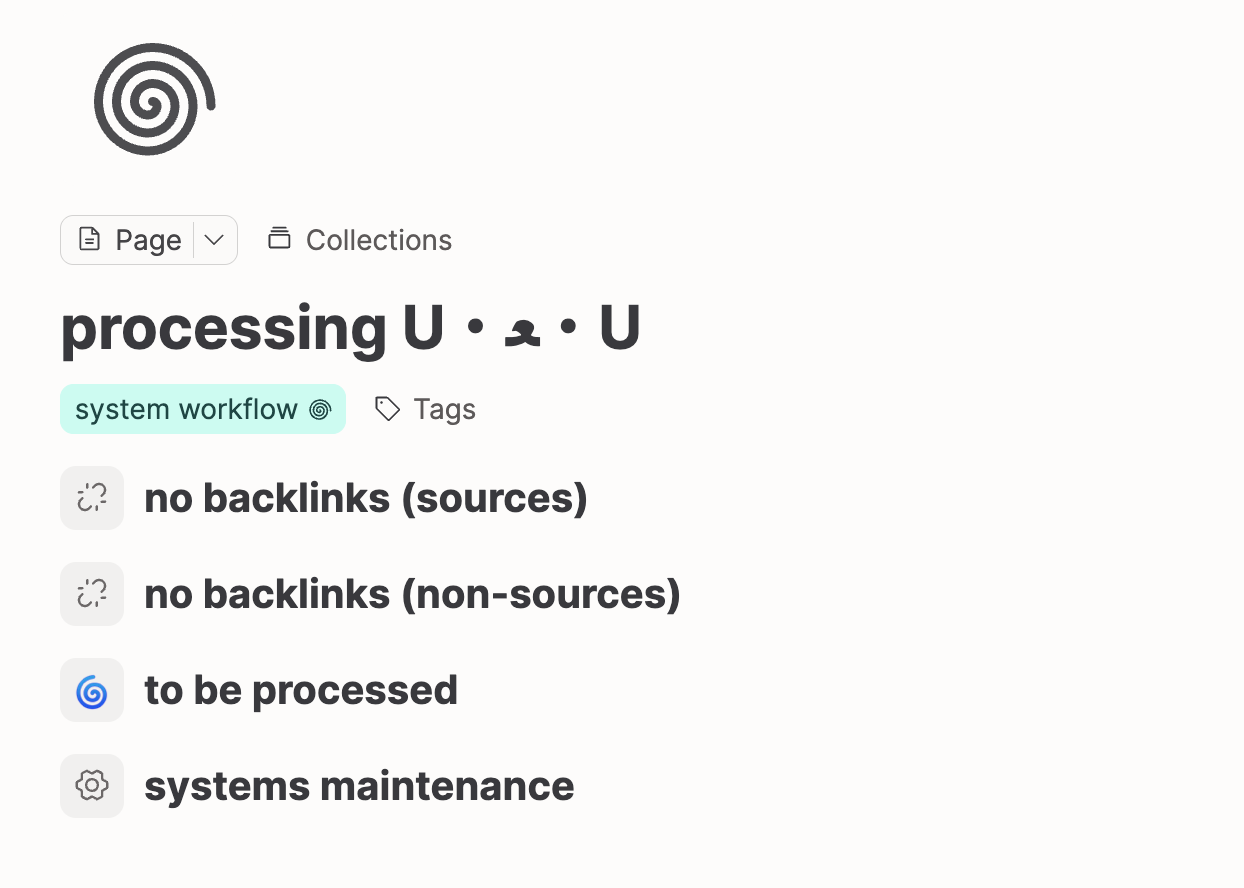
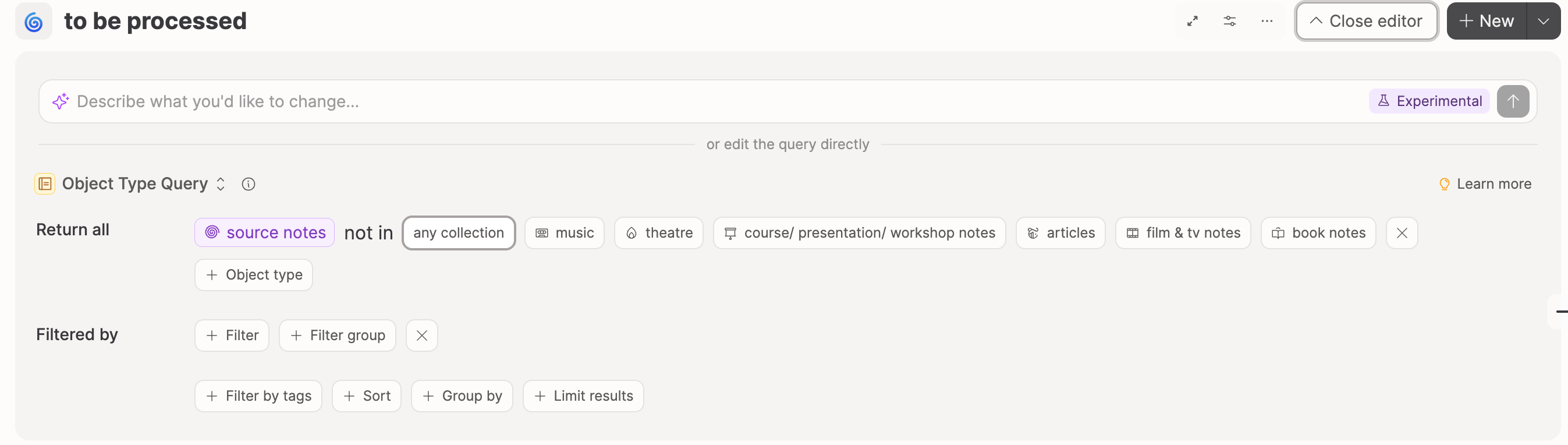
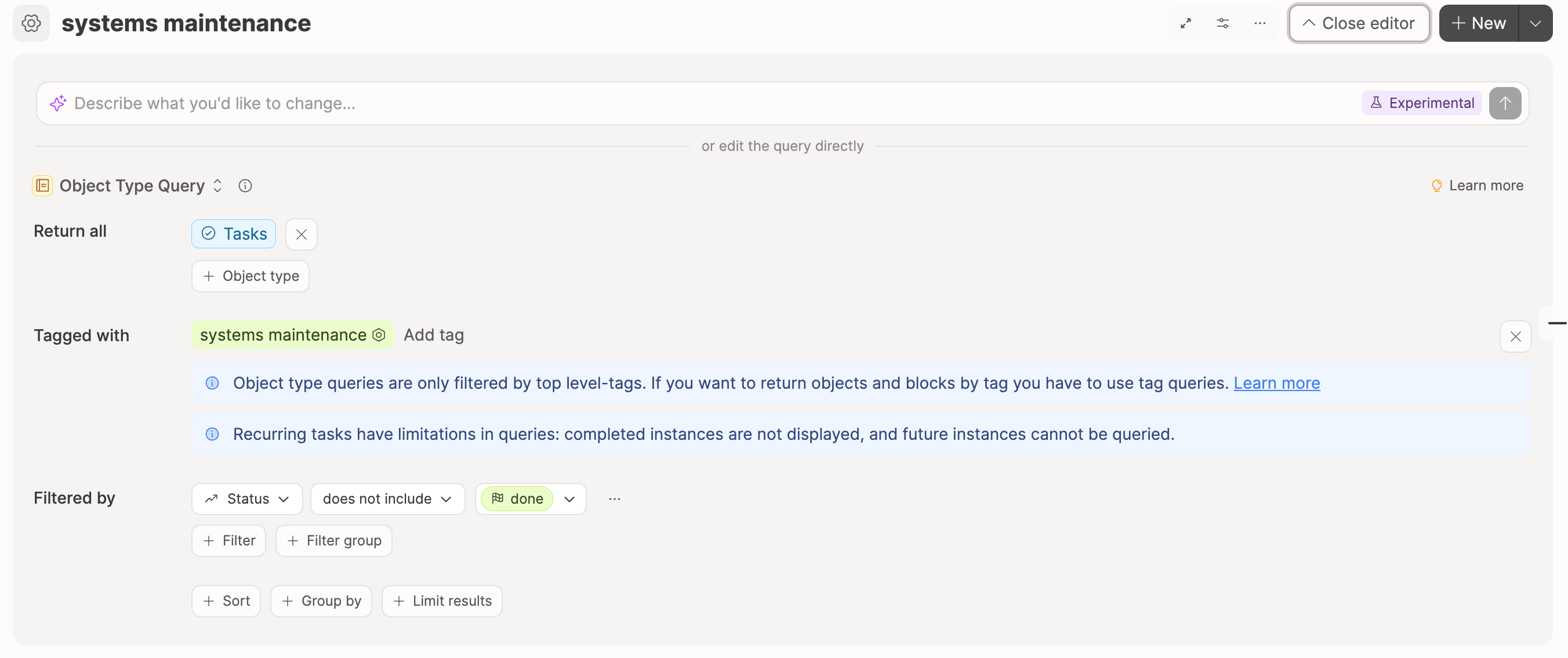
By reviewing your notes and being critical about them, you can start to introduce a meta-practice into your note-taking, which truly turns your research into a life practice. I have a recurring task to review my processing page and go through each query.
Questions you can ask yourself
What are the central topics I seem to be the most interested in?
What do I think I’m interested in, but actually have taken no notes on?
Am I actually that interested, then?
What do I want to spend more time directing my research towards?
I have a ‘log’ object type that I use to note down any large level systems changes I’ve made to my Capacities workflow, and this enables me to sit down and process my reflections and take action on anything that isn’t working.
Make maps as waypoints - MOCs, web weaves
Now that you’ve been taking lots of notes on many different topics, you can start to pull some of these tenuous threads together. I know many people make Maps of Content (MOCs), which can be great ways of visualising all of your content on a topic.
I personally create what I like to call ‘web weaves’ (name pending, I don’t know if it makes the most sense yet). Web weaves are broader scope than maps of content. If a map of content focusses on a singular topic (e.g. existentialism, the medieval era, bogs), a web weave is a more thematic pulling together of disparate threads.
For example, last year I happened to read a lot of books that contained themes of mouths, speech, and language. I noted that down in one of my book notes when I came to that realisation, and then this year I made a web weave referencing those novels.
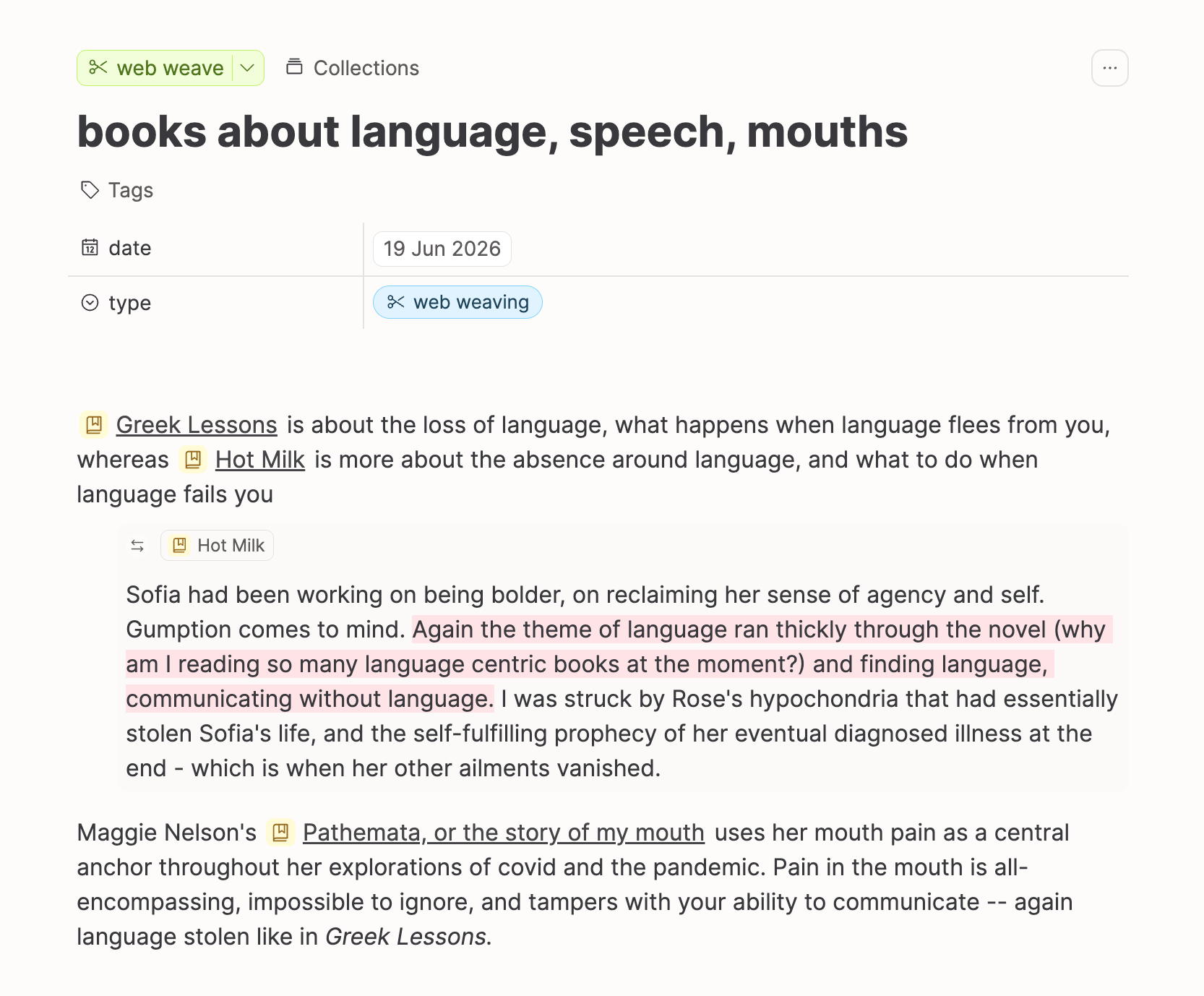
You can also then take these maps and turn them into mini essays if you wanted, or into articles or presentations. You can take your research further. Or you could leave it here. The practice of having engaged with an idea, having followed your curiosity and having pulled threads together to create a new perspective is the most valuable part. Everything else that can come after is secondary.
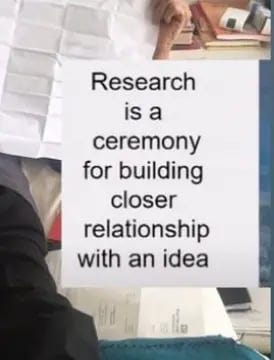
The practice is an end in itself

The more you take notes, and the more you connect and review them, the more your knowledge garden will grow. Along the way, you’ll learn more about who you are as a person; what interests you, what excites you, what calls to you. What are you curious about but not actually spending time learning? What do you think you care about but actually don’t? This process of constant unfolding, of constant learning about myself and how I feel about the world around me and my place in it is far more valuable than a single article or a research paper I could write. A happy byproduct of my research practice for me is that I could write interesting, well cited articles about the things I am passionate about if I wanted to. But most of the time, I’m very happy taking my notes and linking them together.

Are you interested in building a research practice of your own? Do you already have one? I’d love to know!
Wow. Spectacular! Thorough, well-organized, well-written, and better than not boring, deeply interesting.
Love this! Researching has always been a hobby of mine <3
I have a Concepts object which is my primary place for putting what I learn about all sorts of things, and it's fun to look through and reminds me what I need to look into further. I have sections for definitions (when relevant), my thoughts on the concept, the history of it, and the features of it. I really love the related content for the same reason you do.
I love being able to see all of my interests in one place like that, but my research overlaps with other objects like People (for public figures); media (notes I take on whatever I read/watched/etc.); and once in a while, Places.